Talking about feelings at home in two languages
In my home we speak Spanish and English, sometimes in the same sentence. Many families near Waxhaw do the same, with Spanish, Portuguese, Hindi, Arabic or another language. Parents often ask me two things: will two languages confuse my child, and which language should I use when we talk about feelings? Here is what I tell them.
Two languages do not cause confusion
Children who grow up with two languages are not delayed or confused by it. They may mix words for a while, and they may know some words in one language and other words in the other. That is normal, and it evens out. Pediatricians say the same thing: a child learning two languages reaches the big milestones on the same schedule as a child learning one. What matters is that your child hears a lot of warm, rich language. The language itself can be yours.
Your home language keeps the family close
When a child can talk with grandparents, understand the jokes at the table and sing the songs you grew up with, they carry your family with them. The home language is also where many of us keep our tenderness: the pet names, the blessings, the way your mother said "mi amor." Keeping it alive is not a barrier to English. School will take care of English. You are the only one who can give them your language.
Talking about feelings in four steps
A simple way to coach feelings, in any language:
- Notice. Look at the face, the hands, the voice. "I see your fists are tight."
- Name. Give the feeling a word. "You look frustrated." Naming a feeling makes it a little smaller.
- Accept. Let the feeling be there before you fix anything. "It makes sense that you feel that way." Accepting a feeling does not mean accepting every behavior.
- Then help. Once your child feels understood, you can solve the problem together. "What could we try?"
The order matters. If we jump to fixing or correcting, the child stops talking. If we notice, name and accept first, they come closer. This works the same whether you say it in English, in Spanish or in both.
A short bilingual feelings list
Children need words before they can use them. Try these at the table, in the car or at bedtime. Say both and let your child pick.
- feliz: happy
- triste: sad
- enojado, enojada: angry
- preocupado, preocupada: worried
- con miedo: scared
- frustrado, frustrada: frustrated
- orgulloso, orgullosa: proud
- tranquilo, tranquila: calm
Name your own feelings too. "Hoy estoy cansada y un poco frustrada." Children learn feeling words by hearing the adults they love use them about themselves.
Use the language you feel in
Many families find it easier to talk about feelings in their first language. The words come faster and carry more warmth. One study with immigrant parents of bilingual preschoolers found that parents talked about emotions somewhat differently depending on the language they were using. I see it in families I meet: a father who corrects in English but comforts in Spanish. There is nothing wrong with that. Use the language your heart speaks. Your child will feel the message even if they answer you in English.
Mixing is normal
"Estoy sad." "I don't want to ir." Mixing languages is not a mistake. It is a sign that your child is using every tool they have. You can gently repeat the full phrase in one language without correcting: "Ah, estás triste. Cuéntame." Over time their vocabulary grows in both. The goal is connection, not perfect grammar.
Play is a language too
Some feelings are too big for words in any language. Play helps. Five minutes a day of play that your child leads, in whatever language comes out, gives feelings a safe place to show up. I wrote about how to do five minutes of special play time. The Calm Kids Kit has a feelings page and calm-down cards you can print in English or Spanish.
When to get help
If your child has very few words in both languages put together by age two, is hard for people outside the family to understand by age four, or if a teacher raises a concern, ask your pediatrician about a speech and language evaluation that looks at both languages. If big feelings turn into daily meltdowns, fears that stop your child from going places, or sadness that lasts for weeks, talk with the pediatrician or a counselor. The local help page lists bilingual counselors and family services near Waxhaw. In a crisis, call or text 988 (Spanish: press 2, or text AYUDA).
Whatever language you choose today, the message your child needs is the same: I see you, your feelings make sense, and I am here.
Sources
- AAP, Young Children Learning Multiple Languages: Parent FAQs
- AAP, Helping Little People Manage Big Feelings
- CDC, Tips for Noticing and Naming Emotions
- Frontiers in Psychology, via NIH PMC (Huang and Kan, 2021), Chinese American Immigrant Parents' Socialization of Emotions in Bilingual Bicultural Preschool Children
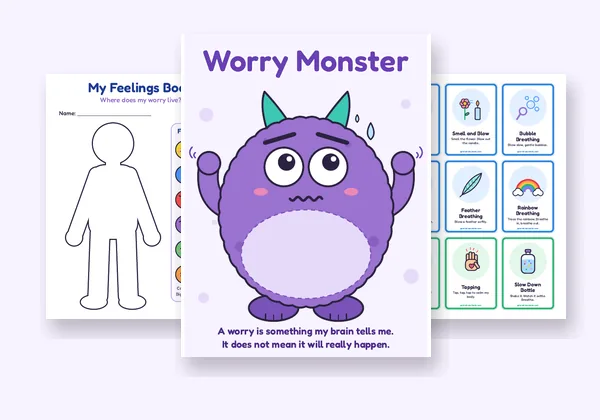
Calm Kids Kit
Coloring pages, Worry Monster, Brave Bear, a brave steps planner, and 18 calm-down cards. For kids about 4 to 10, with a page for parents.
This article is for education only. It is not therapy and does not replace care from a licensed professional. In a crisis, call or text 988 (Spanish: press 2, or text AYUDA).