Stop, Think, Choose: a traffic light for big feelings
Sometimes our body goes fast before our brain has time to think. That one line is the heart of an activity I use with young children, and honestly, it is true for grown-ups too.
When a child grabs, yells, or pushes, it is easy to see a "bad" moment. Most of the time it is a fast body. The feeling arrived first, and the thinking part did not get a turn. The traffic light gives it a turn. It is simple enough for a 4-year-old and useful up to about 8.
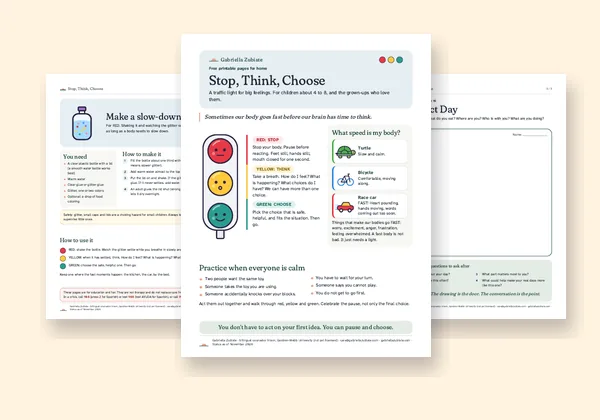
Three speeds
Start with the body, not the behavior. Children understand speeds right away:
- Turtle: slow and calm, like walking on a quiet morning.
- Bicycle: comfortable, moving along, nothing too much.
- Race car: FAST. Heart pounding, hands moving, words coming out before we mean them.
Things that make our bodies go fast: worry, excitement, anger, frustration, and feeling overwhelmed. Notice that excitement is on the list. A fast body is not bad. It just needs a light.
Try asking, at calm moments: "What speed is your body right now?" Children love answering this, and it teaches them to notice before they react.
The traffic light
- RED means STOP. Stop your body. Pause before reacting. Feet still, hands still, mouth closed for one second.
- YELLOW means THINK. Take a breath. How do I feel? What is happening? What choices do I have? We can have more than one choice, and that is the surprise for many children.
- GREEN means CHOOSE. Pick the choice that is safe, helpful, and fits the situation. Then go.
The order matters. We often jump straight to green: "Use your words!" But a race-car body cannot find words yet. Red and yellow come first.
Practice when everyone is calm
Skills learned in the middle of a meltdown do not stick. Skills learned while playing do. In my group we use small role-play cards. You can make your own with index cards, and take turns acting them out with the traffic light:
- Two people want the same toy.
- Someone takes the toy you are using.
- Someone accidentally knocks over your blocks.
- You have to wait for your turn.
- Someone says you cannot play.
- You do not get to go first.
Play both parts. Let your child be the one who knocks over the blocks and the one whose blocks fell. Ask at yellow: "What are two choices here?" Celebrate the pause itself, not only the final choice. "You stopped your body. That was the hard part."
A slow-down bottle for red
A slow-down bottle is a clear bottle with water, clear glue, and glitter. When a child is at red, they shake it and watch the glitter settle while taking slow breaths. The settling takes about as long as a body needs to slow down. Then yellow: think. Then green: choose. Some families keep one in the car and one in the kitchen.
What to say in the moment
- "Red light. Let's stop our bodies together."
- "Yellow. One breath. What is happening right now?"
- "What are our choices? I can think of two."
- "Green. Which one is safe and helpful?"
- Afterward: "You paused. I saw it. That is what strong looks like."
Keep your own voice at turtle speed while you say these. Children borrow our speed.
Books to read together
Stories make the idea stick. These picture books about worry and big feelings are a good place to start:
- Ruby Finds a Worry, by Tom Percival
- The Don't Worry Book, by Todd Parr
- Worry Says What?, by Allison Edwards
- How Big Are Your Worries, Little Bear?, by Jayneen Sanders
- In Spanish: El monstruo de colores, by Anna Llenas, and The Feelings Book / El libro de los sentimientos, by Todd Parr (bilingual)
Your local library probably has most of them. Ask the children's librarian for more books in Spanish.
The idea underneath
You don't have to act on your first idea. You can pause and choose. When children hear that, and see us do it, they learn that a big feeling is not an emergency. It is a signal to slow down. That is a skill they will use for the rest of their lives.
Sources
- American Academy of Pediatrics (HealthyChildren.org), 4 Play Activities to Help Children Manage Emotions
- Child Mind Institute, How to Help Children Calm Down
- CDC, Tips for Noticing and Naming Emotions
Stop, Think, Choose: printable pages for home
The traffic light with its three steps and the turtle, bicycle and race car speeds, how to make a slow-down bottle, and a My Perfect Day drawing page with questions for grown-ups. For children about 4 to 8, plus a page for ages 6 to 16.
This article is for education only. It is not therapy and does not replace care from a licensed professional. In a crisis, call or text 988 (Spanish: press 2, or text AYUDA).